
Polish Jews and the Yiddish Language in Mexico: Echoes of a Forgotten Diaspora
By Thao Nguyen and Jana Mazurkiewicz Meisarosh
A Brief Introduction to the Yiddish Language
Yiddish is a Jewish language that developed in the Rhineland region of Central Europe around the 9th-10th centuries. It emerged among Ashkenazi Jewish communities as a fusion of Middle High German dialects, Hebrew and Aramaic. As European Jews migrated East, the language gradually acquired Slavic and Romance influences. For centuries, Yiddish functioned as a shared language of daily life, culture, and creativity across diverse Jewish communities.
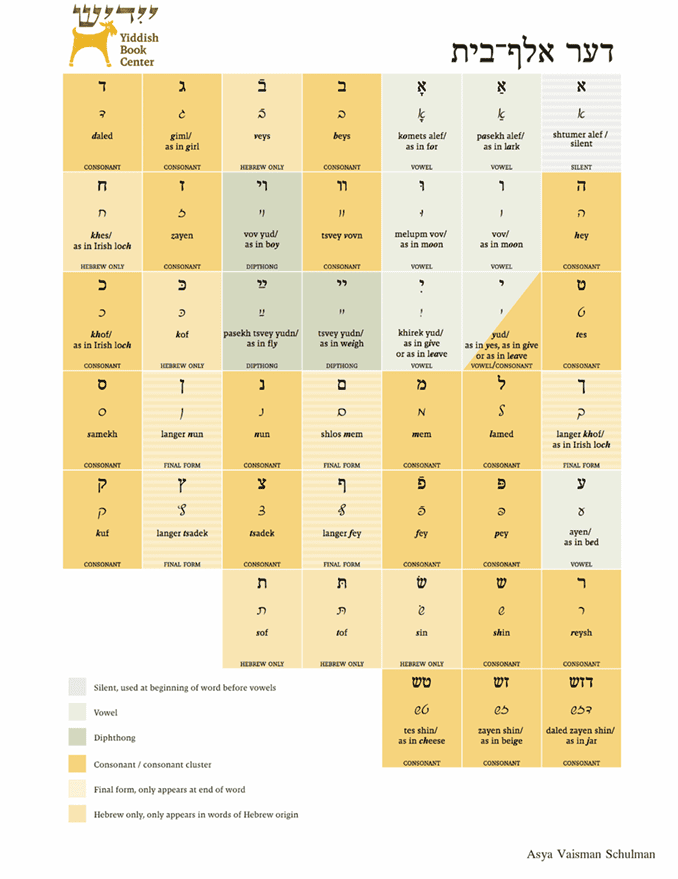
Yiddish alphabet (Source: Yiddish Book Center)
By the late nineteenth and early twentieth centuries, Yiddish had become the most widely spoken Jewish language in the world, with nearly 11 million speakers. It supported the many Jewish communities throughout Europe, and increasingly, beyond, which used the language in literature, journalism, theater, education, and political debate. Yiddish was not only spoken. It was lived.
That world was profoundly disrupted in the twentieth century. The collapse of empires, antisemitic violence, genocide in Europe, and later pressures of linguistic assimilation in different national contexts drastically reduced the number of Yiddish speakers. World War II and the Holocaust almost completely annihilated Yiddish and its millions of native speakers. Today, there are still Yiddish speakers, but the language is not even close to the rich network that existed in Europe before World War II. Fewer than two million people speak Yiddish, often not as a primary language. Those who do speak Yiddish as a first language are, primarily, members of insular religious communities, or are part of the aging communities that learned the language at home before World War II.
Yet Yiddish did not disappear. It moved.
Migration and Reconfiguration
The large European empires that most Yiddish speakers lived within provided a fragile but workable framework for Jewish life. However, this framework fell apart when these empires began to collapse in the late nineteenth and early twentieth centuries. New nation-states emerged, often built around ethnic identity, and Jews found themselves economically and socially displaced.
While violence against Jews played a role in driving migration, economic pressures were the primary drivers. A desirable destination then was the United States, but the 1921 Emergency Quota Act, which severely restricted immigration, sharply limited Jewish entry and forced many to seek alternatives, such as Mexico, which at the time was more welcoming to immigrants. As a result, many Eastern European Jews migrated to Mexico in the late nineteenth century, with a larger wave occurring between 1900 and 1930. Most came from regions where Yiddish was the everyday language, including present-day Poland, Lithuania, Ukraine, Belarus, and Russia.
Although Mexico City has the largest Jewish community in Mexico, Yiddish speakers have also resided in other cities, such as Monterrey, Torreón, Tijuana, La Paz, Cabo San Lucas, Guadalajara, Ajijic, Puerto Vallarta, San Miguel de Allende, San Cristobal de las Casas, Cozumel, Cancun, Tulum, and Playa del Carmen.
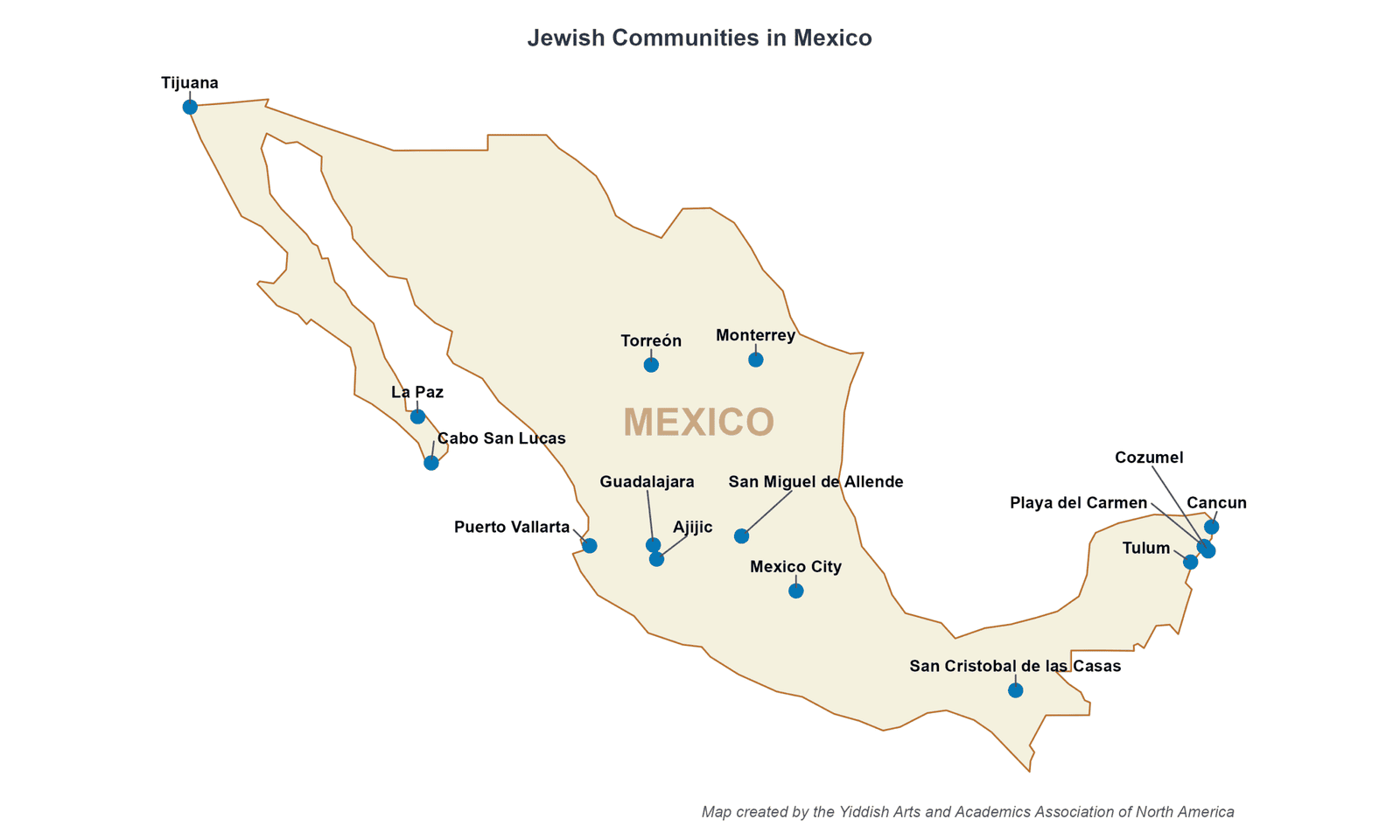
Jewish communities across Mexico (Source: Yiddish Arts and Academics Association of North America)
Yiddish in Mexico: Language in Daily Life and Community
Since Ashkenazi Jews arrived in Mexico from diverse parts of Eastern Europe, often speaking different local languages or dialects, Yiddish functioned as a common language during their first years in Mexico and was unfamiliar with the local language.
As soon as they could, Jewish immigrants began creating the institutions that would anchor their new lives. This was how the Colegio Israelita de México, the first educational institution for children of Jewish immigrants, was founded in 1924. Over time, the school expanded to include all educational levels from pre–school to high school. It also featured facilities such as a swimming pool, soccer field, and cafeteria, providing students with a well-rounded educational environment that supported both their academic and physical development despite limited financial resources at that time. The school follows the Mexican national curriculum while also teaching Yiddish and Jewish history, and since then it has been producing many generations of accomplished professionals in a wide range of fields throughout its century-long history, among them economist and athlete Marcos Schwartzman, robotics innovator Alberto Buzali Berner, and educator Dafe Kusulas. In recent years, Colegio Israelita de México evolved into Colegio Olamí ORT, following its 2022 merger with Colegio Hebreo Sefaradí. Now part of the global World ORT network, it integrates cutting-edge programs in STEAM education, project-based learning, and international collaboration, preparing students for a self-sufficient and innovative future.
Around the same period, the Hebreo Monte Sinaí School was established by the Sephardic community in 1943, offering instruction in Hebrew, Spanish, and Judeo-Spanish (Ladino). Today, it stands as one of Mexico City’s most respected Jewish institutions, known for its rigorous bilingual curriculum and emphasis on values-based education rooted in Sephardic heritage. The school integrates International Baccalaureate (IB) and Cambridge programs, preparing students for global academic standards while maintaining strong ties to Jewish identity and tradition. Its campus hosts vibrant cultural events such as the Festival Aviv and Semana Cultural, where students celebrate Jewish art, music, and history alongside Mexican civic life. Beyond academics, Hebreo Monte Sinaí fosters community engagement through partnerships with local universities and organizations, encouraging students to participate in volunteer initiatives, interfaith dialogues, and cultural preservation projects.

The Hebreo Monte Sinaí School at its former location on 120 Zacatecas Street, Colonia Roma, Mexico City (the building now houses the University of Communication)
(Source: Wikipedia)
Yiddish cultural life in Mexico extended well beyond daily communication and into literature, theater, and political expression. Yiddish newspapers and journals – most notably Di Shtime (The Voice), founded by Moisés Rubinstein Badash in 1937 – served as not only news outlets but also as platforms for poetry, short stories, essays, and political debate, reflecting both global Jewish concerns and local Mexican realities. Yiddish literature often featured themes of migration, labor, antifascism, and the tension between old-world traditions and life in a new, Spanish-speaking country. Writers and poets composed works that situated Jewish experience within the Mexican landscape, blending memories of Eastern Europe with images of Mexican streets, markets, and working-class neighborhoods.
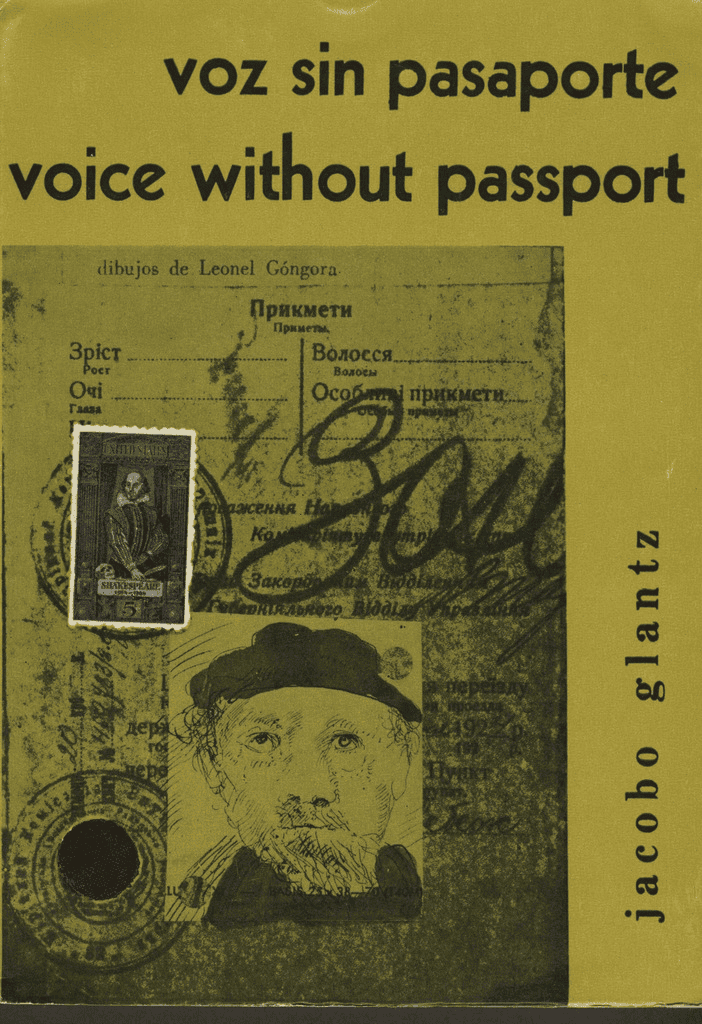
Jacobo Glantz, Voz sin pasaporte/Voice without passport (1965) (Source: Open Door Archive)
Yiddish theater also played an important role in community life. Like many immigrant communities settling in a foreign land, Jewish immigrants sought to preserve their culture and identity. Amateur theater groups staged Yiddish plays and readings, bringing classic Yiddish dramas as well as contemporary works to local audiences. The works selected for performance often reflected the sentiments of the time. For newcomers rebuilding their lives and establishing themselves in a new country, these included theatrical performances that emphasized perseverance and dedication, such as the poem HaMatmid by Chaim Nachman Bialik and the stories of Sholem Aleichem, who wrote about ordinary Jewish people living in small towns (shtetls) in Eastern Europe during the late nineteenth and early twentieth centuries. These performances became important cultural events that reinforced the use of the Yiddish language while fostering a shared emotional and artistic space.
Additionally, Yiddish cultural organizations, such as libraries, literacy circles, and leftist Jewish associations, helped preserve and circulate Yiddish texts.
As immigrants gradually learned Spanish, a bilingual environment emerged where many first-generation Jews spoke Yiddish at home and in the community and Spanish in business and public interactions. By the 1940s and 1950s, Spanish had become dominant among the second generation. While many children understood Yiddish, fewer spoke it fluently. Nevertheless, Yiddish remained emotionally and symbolically important, especially in community events, humor, music, and memory.
Yiddish in Present Time
Today, Yiddish in Mexico is maintained through the efforts of individuals and community initiatives, especially in Mexico City, where much of the country’s Jewish life is concentrated. Smaller yet active communities in Monterrey, Guadalajara, Tijuana, La Paz, and Cabo San Lucas also help sustain Jewish cultural traditions through synagogue life and cultural events. Cancún, a rapidly growing community shaped by tourism and expatriates, adds a new dimension to Jewish life in Mexico.
Rather than functioning as an everyday vernacular, Yiddish now persists as a language of memory, scholarship, and cultural revival through efforts by modern Mexican Yiddishists. One of them is Arturo Kerbel, a lifelong Yiddish activist who has fought against the language’s decline Yiddish in various ways. He led student efforts opposing the exclusion of Yiddish from educational curricula, partnered with fellow Yiddish activists to offer language classes and cultural activities, and promoted the language through community initiatives. Arturo also contributes regularly to In geveb, where he shares Yiddish culture through essays, interviews, and personal reflections.

Arturo Kerbel
Tamara Gleason Freidberg is another important figure who promotes Yiddish culture through both her scholarship and her involvement in Yiddish community initiatives. She has published scholarly works on Mexican Yiddish literature and the Jewish left in Mexico, while also contributing to initiatives such as Yiddish Open Mic London and Yiddish House London, helping sustain a vibrant international Yiddish community. More recently, she has been involved in organizing Yiddish gatherings in New York in collaboration with Yugntruf (“call to youth” in Yiddish), a nonprofit organization with a mission to promote the use of Yiddish among younger generations and the broader community. Her diverse activities highlight her strong commitment to preserving and expanding the presence of Yiddish across different communities and settings. Like Arturo, Tamara is also a contributor to In geveb.
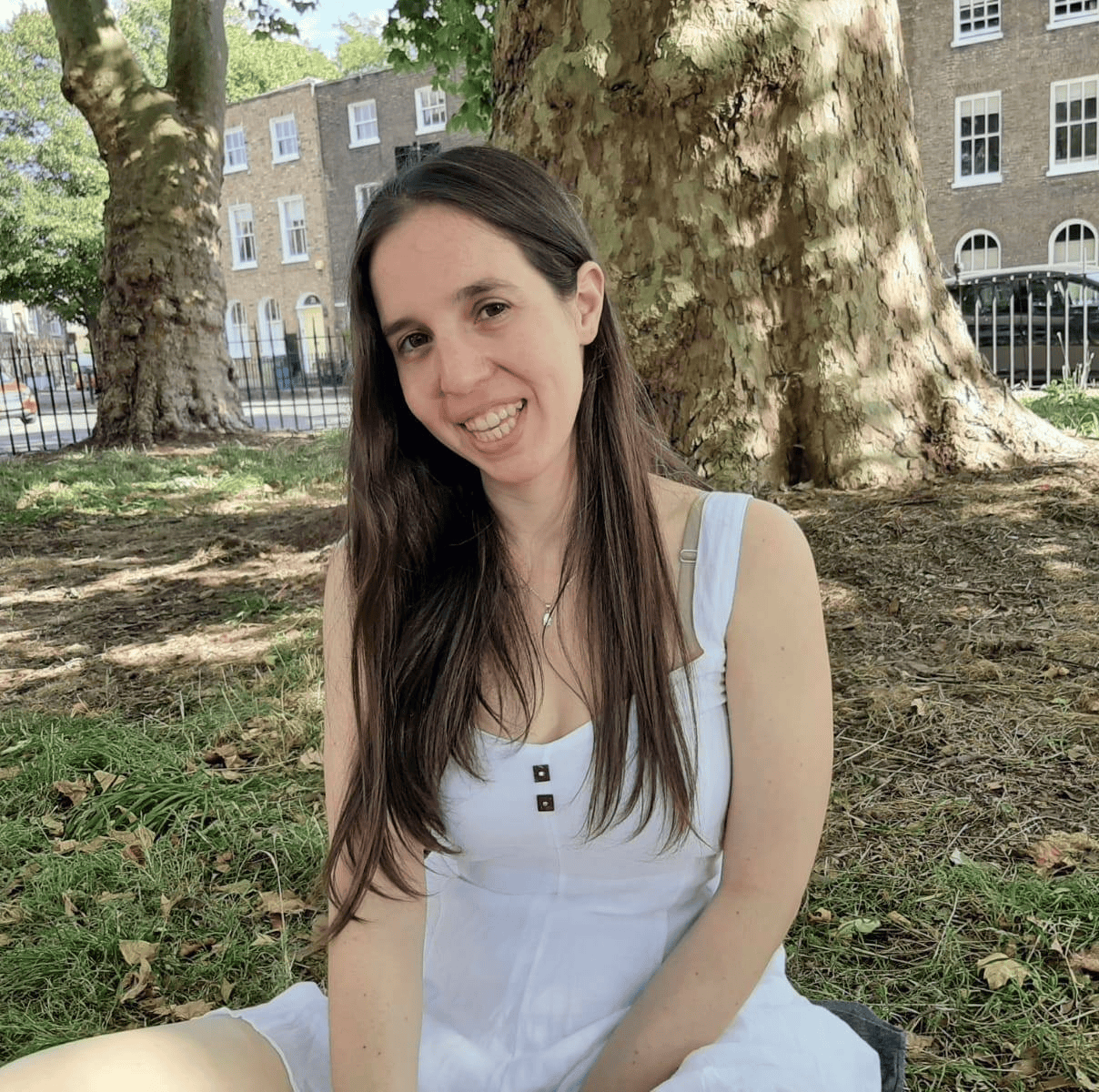
Tamara Gleason Freidberg
These efforts are complemented by organizations dedicated to preserving and promoting the Yiddish language. One notable example is Yiddishland California, a traveling cultural center and museum designed to bring Yiddish language, history, and creativity into direct dialogue with contemporary communities. The recent opening of Yiddishland California in La Paz marks a new chapter in the Mexican Yiddish story. Through exhibitions, language classes, lectures, film screenings, and community events, Yiddishland creates accessible spaces for learning, exchange, and cultural continuity. Programming includes both in-person and online activities, expanding participation beyond geographic boundaries.

Together, these initiatives show that while everyday Yiddish-speaking communities have largely faded, the language continues to live within Mexico’s Jewish urban centers as well as in emerging and transnational spaces. Yiddish today is not defined by where it is spoken most, but by the communities that actively choose to sustain it.
References
Yiddish language | History, Culture & Alphabet | Britannica
Yiddish Language | Language and Linguistics | EBSCO Research
History of the Jews in Mexico | Jane Rosenthal
Why do Jews migrate, and when? | JPR
Di Shtime 1943 at the CDIJUM – Jewish Link
The History and Legacy of Jewish Immigrants to Mexico Over Time
A Brief History of Jews in Mexico – Lake Chapala Jewish Congregation
Glants, Yankev — Congress for Jewish Culture
El Colegio Israelita de México: 90 años de existencia | Diario Judío